
Metropolitan Stock Exchange of India (MSE) plans to raise Rs 120 crore from investors in an attempt to stay afloat. The beleaguered exchange's board has approved issuance of 1.19 billion equity shares of face value Rs 1 at a premium of Rs 1 through private placements, according to a disclosure on its website.

The first leap towards an organized derivatives market came in 1848, when the Chicago Board of Trade, the largest derivative exchange in the world, was established. Today, equity and commodity derivative markets are rapidly gaining in size in India. In terms of popularity too, these markets are catching on like a forest fire.

National Stock Exchange (NSE) chief Ashishkumar Chauhan on Friday cautioned retail investors against trading in derivatives and suggested them to invest in equities through mutual fund route. He emphasized that trading in Futures & Options (F&O) derivatives should be limited to informed investors who can manage risk and comprehend the market. Recently, Finance Minister Nirmala Sitharaman and chief economic advisor V Anantha Nageswaran flagged the growing risk of F&O trading for retail investors.

Finance Minister Nirmala Sitharaman on Thursday said the government cannot restrain retailers from trading in Futures and Options (F&O) but will definitely create awareness regarding the risks involved in putting money in such instruments.

From the 30-Sensex firms, Trent, Infosys, Bharti Airtel, Tech Mahindra, Bharat Electronics and Maruti were among the biggest gainers. However, State Bank of India, Kotak Mahindra Bank, Larsen & Toubro and Titan were the laggards.

The Securities and Exchange Board of India (Sebi) on Wednesday overhauled the cost framework for the 80 trillion domestic mutual fund (MF) industry, introducing a simplified structure aimed at improving transparency for investors while balancing the impact on asset managers.

Sebi Chairman Tuhin Kanta Pandey announced intensified surveillance and technology-driven enforcement to combat pre-investment scams targeting retail investors, who are increasingly being lured by fake trading apps and promises of high returns.

The recent correction suggests that while precious metals hedge geopolitical tension and inflation, they are not immune to sharp short-term corrections and profit-booking.

BSE (formerly Bombay Stock Exchange) has seen its market share go past the critical 20 per cent mark in the derivatives segment, intensifying its battle with bigger rival - the National Stock Exchange (NSE) - which, less than a year ago, had a monopoly in this space. In April, the average daily trading volume (ADTV) for BSE stood at Rs 89 trillion, accounting for 20.6 per cent of the overall ADTV of Rs 432 trillion (based on notional volumes for options).

The National Stock Exchange (NSE) on Monday said it will conduct a special Muhurat trading session on Tuesday, October 21, to mark the festival of Diwali.

Bharat Electronics, Reliance Industries, Mahindra & Mahindra, Larsen & Toubro, InterGlobe Aviation, ICICI Bank and UltraTech Cement were among the other major gainers. Axis Bank, Infosys, Tata Consultancy Services, Trent and Titan were the laggards.

The 'rescue' operation occurred within kilometres of Iran's underground tunnel complex at Isfahan, assessed by the IAEA and US intelligence as holding a substantial portion of the country's 60 per cent enriched uranium stockpile. Retired senior US military officers have highlighted that the mission's footprint -- hundreds of special operators, multiple heavy-lift aircraft deep inside Iran -- appears outsized for recovering a single airman. Prem Panicker continues his must read blog on the Iran War.

The National Stock Exchange (NSE) on Tuesday said it has halved the lot size for trading derivatives contracts for the Nifty 50 index to 25 and also reduced the lot sizes of the Nifty Financial Services and Nifty Midcap indices as part of its periodic revision. "All contracts, i.e. weekly, monthly, quarterly, and half-yearly expires available for trading from the trade date of April 26, 2024, onwards will be with the revised market lot size," the NSE said, referring to applicability of the change for Nifty 50. The lot size in the derivatives segment refers to the fixed number of shares in a unit or group for which contracts are traded.

Trump said that the decision would be "immediately" in effect and that the "order is final and conclusive."

Rediff explains why the system, not the Budget, is the problem.
The BSE is planning to reintroduce its Sensex-30 derivatives and is in the process of collecting feedback from members, the MD and CEO of the premier bourse, Sundararaman Ramamurthy, said on Friday. The Sensex-30 derivatives products (options and futures), which were launched in 2000, had failed to generate much interest among investors compared to the rival exchange's Nifty-50 derivatives. "We are trying to reintroduce Sensex-30 derivatives, and have started the consultation process by taking the feedback of market participants," Ramamurthy said at an Assocham-organised event in Kolkata.

The settlement cycle for cash, derivatives, and securities lending and borrowing mechanism (SLBM) segments has been revised after September 5 and September 8 were declared as settlement holidays by clearing corporations, markets regulator Sebi said on Monday.

Stock market is gearing up for an eventful week ahead where key triggers such as quarterly earnings from corporates, the US Fed interest rate decision and the upcoming Union Budget for 2026-27 would grab the limelight, analysts said.
It is an Internet-based government regulated derivatives exchange where traders can hedge against or speculate on economic events and price movements.
BSE's fresh shot at cracking the derivatives market is off to a promising start. However, Asia's oldest bourse is facing resistance from brokerages with nearly 10 large brokers yet to offer the relaunched Sensex and Bankex derivatives on their platforms. Many brokers maintain that they are working on the back end to enable BSE derivatives on their apps and websites. Some said while volumes are picking up, they are still miniscule compared to bigger rival NSE, which is the most-preferred venue for derivatives trading. Only a few brokers responded to formal queries sent by Business Standard on the issue of allowing BSE derivatives on their platform.

The National Stock Exchange (NSE) has withdrawn its decision to change the expiry day for Bank Nifty derivatives contracts from Thursday to Friday. The move follows a "request" from the BSE, which settles its Sensex and Bankex derivatives contracts on Friday. The proposed change in Bank Nifty settlement was scheduled to be effective from July 6 with the first weekly expiry on July 14.

From the Sensex pack, Eternal, Bharat Electronics Ltd, Trent, Axis Bank, State Bank of India, Bajaj Finance, Sun Pharmaceuticals, Asian Paints, Adani Ports, Hindustan Unilever, Reliance Industries, ITC, PowerGrid, Tata Motors Ltd's Commercial Vehicles business, and Bajaj Finserv were the gainers. Infosys, Tata Motors Passenger Vehicles, Tata Steel, ICICI Bank, Tech Mahindra, Titan, UltraTech Cement, Maruti Suzuki India, and Larsen & Toubro were the laggards.

The Securities and Exchange Board of India (Sebi) on Tuesday announced that the top 500 stocks will be eligible for the same-day settlement cycle (T+0) in a phased manner. This move is seen as a fresh push to ready the market ecosystem to speed up the settlement cycle, which currently stands at T+1.
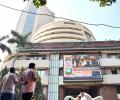
'BSE has facilitated nearly Rs 35 trillion in capital raising across multiple segments.'

Capital markets regulator Sebi has extended the suspension of futures and options trading in seven agricultural commodities, including wheat and moong, for one more year till December 2023 in a bid to rein in prices. The other agricultural commodities suspended by Sebi are -- paddy (non-basmati), chana, crude palm oil, mustard seeds and their derivatives and soya bean and its derivatives. "The suspension of trading in the above contracts has been extended for one more year beyond December 20, 2022, i.e. till December 20, 2023," Sebi said in a statement on Wednesday.

The Reserve Bank of India (RBI), in its Financial Stability Report (FSR), cautioned that stress tests indicate two scheduled commercial banks (SCBs) may have to dip into their capital conservation buffers (CCBs), unless stakeholders infuse capital, under a scenario involving a gradual slowdown in domestic GDP growth and a moderate rise in inflation, with limited policy easing space available to the central bank.

'We operate in an economy that is structurally positioned for long-term growth. As market levels rise over time, our AUM grows in line.'

A ban on US-based high-frequency trader (HFT) Jane Street did little to dent activity in the derivatives segment, with July volumes rising 10 per cent month-on-month to an eight-month high. Analysts and experts said the jump may have come from proprietary and retail traders, spurred by a spike in market volatility.

Unless the primary market momentum slows, smallcap stocks will stay subdued.
Sebi aims to stay proactive as HFT and quant firms like Citadel Securities, Optiver, Millennium, and IMC Trading are expanding rapidly in India, which is home to the world's largest derivatives market by contracts traded.

So far this year, the rupee has fallen by 4.2 per cent, the worst among its Asian peers.
'Sebi's move to cap brokerage charges will help investors by lowering the overall cost of investments.'

Market participants do not expect any immediate impact on the rupee from the Reserve Bank of India's (RBI's) a "comprehensive" master direction aimed at strengthening the framework for hedging foreign exchange risks. RBI Governor Shaktikanta Das, in his monetary policy statement, revealed that the central bank is poised to issue a master direction to consolidate guidelines for all types of forex transactions. But this development, according to market players, is more of a directional guidance than a mandatory directive.
'The investigation is at a very critical stage. We are not going to give every single document.'

The National Stock Exchange (NSE) has deferred its plan to change the expiry day of all index and stock derivatives to Monday from Thursday until further notice following markets regulator Sebi's consultation paper. The shift, which was scheduled to take effect on April 4, 2025, would have seen all index and stock derivative contracts move from Thursday to Monday.
The Dubai Gold and Commodities Exchange, set up by Dubai and two partners from India and the first electronic multi-commodity derivatives exchange in the Middle East, will commence trading in November this year in precious metals contracts.
Sebi's probe against Jane Street is part of its efforts to mitigate losses for individual derivative traders.

Assessing where their funds are flowing gives traders a hidden edge in predicting the market direction and momentum.
